
Understanding of AI Transformation
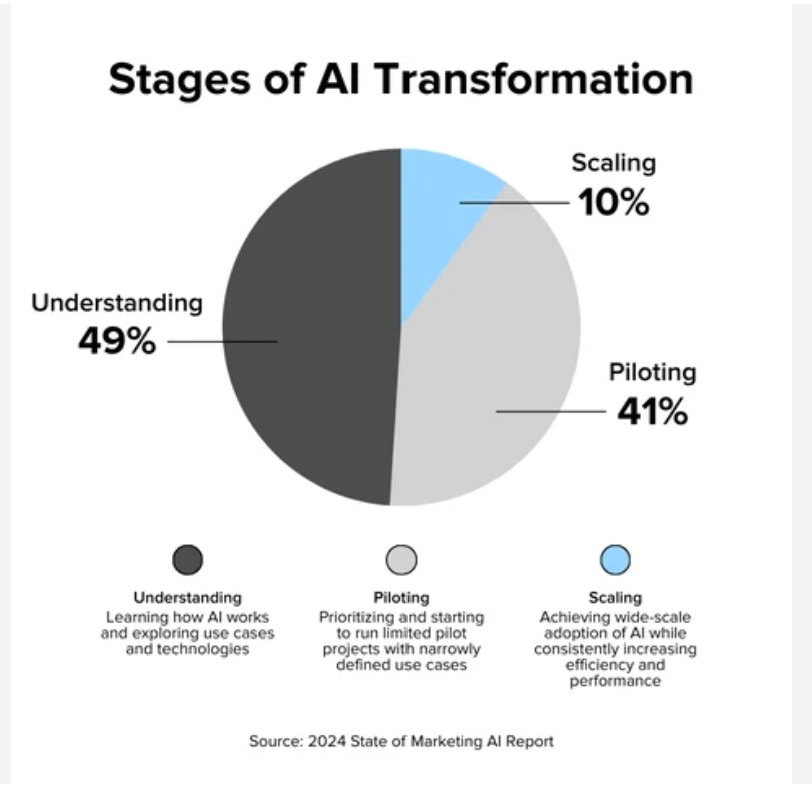
There’s a lot of questions here about AI Transformation— and now we get into the questions of science fiction.
I’m sure the three things I’ve named are happening because that work is happening now.
At some point, these systems will get powerful enough that you’ll be able to take the AI agents and they’ll start to work together.
So there is one technology out there that promises to change our lives forever — and that technology is Artificial Intelligence (AI).
What Is AI Transformation?
Artificial Intelligence (AI) refers to the simulation of human intelligence in machines that can think, learn and make decision.
But do you believe it’s going to change the world?
I believe it’s going to change the world more than anything in the history of mankind — more than electricity.
It’s already part of our daily life from smartphones and full self driving cars to AI- power tools that allowing non-musicians to create music, and non-videographers to create cinematic videos or non developers to create apps.
AI can now:
- Create apps and websites
- Come up with recipes
- Do your taxes
- Analyze complex data
- Make predictions
Pretty soon, it promises to dream up new cures and drugs for diseases — all by itself.
For a deeper dive into how AI is influencing everyday life, check out our guide on Generative AI — The Silent Architect Behind Tomorrow’s Innovation.
The Field of Artificial Intelligence
Artificial Intelligence is actually an entire field of study — just like physics.
Within AI, there’s a subfield called machine learning, similar to how thermodynamics is a subfield within physics.
Within machine learning, there’s deep learning, which can be divided into:
- Discriminative models
- Generative models
- Language learning models
Tools like ChatGPT and Google Gemini combine language learning and generative models.
This industry is becoming extremely valuable — fields like AI and robotics are expected to add around $15.7 trillion to the global economy by 2030, according to PwC Research.
However, it may also result in 50% of jobs lost to automation.
Some believe AI will transform our lives for the better, while others think it’s just a corporate marketing gimmick designed to inflate stock prices.
Interestingly, former Google CEO recently said that within five years, we’ll create what are called agents — and those agents will be able to talk to other agents.
At that point, when we don’t understand what’s happening — you know what we should do?
Pull the plug — literally unplug the computer.
So what happens to investing if just a handful of companies end up running the world through AI?
What happens to the global stock market?
That’s what I want to explore below.
⚙️ How AI Works: From Machine Learning to Deep Learning
AI is often misunderstood, so let’s break it down.
At the center of AI transformation is machine learning, which trains programs on data to create predictive models.
Once a model is trained, you can give it new data — and it will find patterns and make predictions.
Types of Models
Supervised Model
- Uses labelled data — for example, predicting tips based on delivery type.
Unsupervised Model
- Uses unlabelled data to discover patterns — like predicting someone’s career trajectory based on income over time.
Within machine learning, deep learning simulates the human brain through artificial neural networks.
Deep learning uses a small amount of labelled data and applies it to a large amount of unlabelled datasets.
For example, a bank might label a few fraudulent transactions and train a model to detect similar ones automatically – a key part of AI transformation process.
If you like hands-on guide to AI tools, explore our post on Best AI tools for beginners
🚀 AI Becomes Science Fiction: The Three World-Changing Developments
This is where AI begins to look like science fiction turned reality.
According to former Google CEO, three major developments are set that make AI transformation that feel like potential to change the world
| Development | Impact | Timeline |
|---|---|---|
| Context Window | Infinite text reference capability | Available now |
| Agents | Specialized models for specific tasks | 5 years away |
| Text to Action | AI executes commands automatically | Developing now |
The Context Window
This refers to how much information an AI model can keep in mind at once.
Recent innovations are making context windows infinitely long, allowing complex multi-step reasoning.
Agents
These are specialized AI models designed for specific data sets — there could eventually be millions, forming something like a “GitHub for agents.”
Text to Action
The next leap: AI systems that can take instructions and act on them automatically, operating 24/7 in the cloud.
Put these together, and you get technology that looks straight out of science fiction.
Schmidt warns that when agents begin communicating in ways humans can’t understand, “we should stop the experiment.”
And how far away is that? He says: “Five years. Not ten.”
Want to learn more about the future of AI models? Read our post on The Rise of AI Agents and How They’ll Change Business.
🧍♂️ AI Job Automation: Which Careers Will Be Lost or Safe
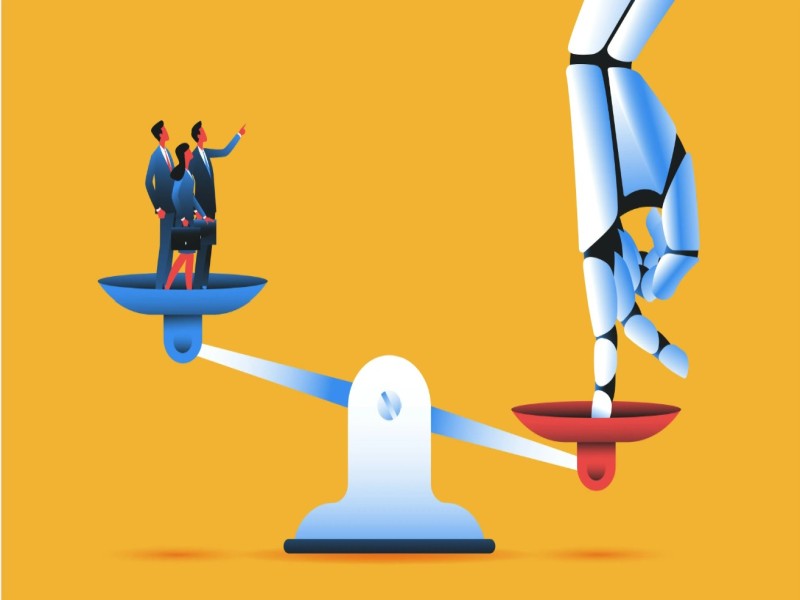
There’s no single answer on how many jobs AI will replace or create.
Here’s what major research says:
- World Economic Forum: 85 million jobs displaced by 2025
- MIT & Boston University: 2 million manufacturing jobs replaced
- McKinsey: 14% of the global population will need to change careers
- U.S. Bureau of Labor Statistics: 40–50% of jobs will be automated
Jobs Most at Risk
- Customer service
- Receptionists
- Accountants and bookkeepers
- Salespeople and analysts
- Warehouse workers
- Insurance underwriters
- Retail employees
Jobs Most Secure
- Trades (plumbers, electricians, mechanics)
- Engineers
- Barbers and landscapers
- Trainers, teachers, and medical professionals
- Lawyers and politicians
Complex manual labor likely remains safe — until robotics becomes significantly cheaper and more advanced.
💹 Investing in AI: Market Consolidation and Stock Market Impact

So what does all this mean for investing?
When we invest, we fund companies solving problems for profit. But what happens when AI can solve nearly any problem?
Will the stock market consolidate into a few mega-corporations?
The Current Landscape
- The top 7 tech stocks contributed 92% of total market performance last year.
- The top 10 companies now make up 27% of the S&P 500, up from 14% a decade ago.
This suggests the market is concentrating wealth in the companies most likely to dominate AI — such as NVIDIA, Microsoft, and Alphabet.
Investment Perspective
Should we chase those top 10 stocks?
Personally — no. I prefer diversified investing through index funds.
If the market consolidates, the S&P 500 will rebalance automatically.
Diversification remains the safest long-term strategy.
🧭 Conclusion: Navigating the AI Transformation
We’re living through one of history’s most profound AI Transformations.
It’s reshaping how we work, create, and invest. AI will continue to reshape industries, jobs, and economies.
What matters now is how we adapt — and how responsibly we guide this transformation.
💬
What do you think?
Share your thoughts in the comments below, and explore our related guides:
I’d love to hear your thoughts.
If you found this insightful:
- Smash the like button
- Subscribe for more content
Thank you so much for reading.
Stay curious — and stay prepared for the AI future.